 Zacharia Hildreth
The Disciples Were Called Christians First at Antioch
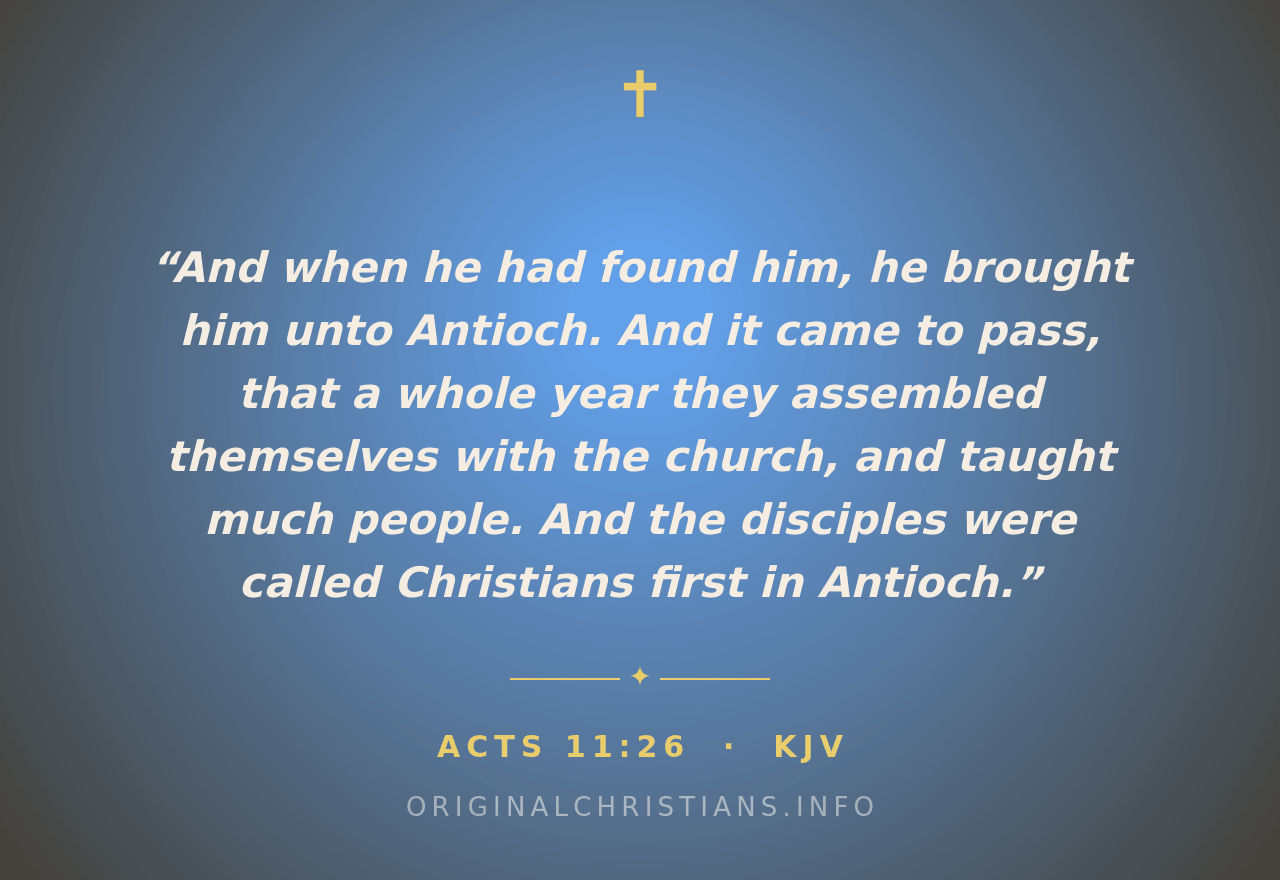
"And when he had found him, he brought him unto Antioch. And it came to pass, that a whole year they assembled themselves with the church, and taught much people. And the disciples were called Christians first in Antioch." — Acts 11:26, KJV
It is one of the quietest verses in the book of Acts, and one of the most important.
For roughly a decade after the resurrection of Jesus, the movement He founded had no label of its own. Its members called themselves "the disciples" (Acts 9:1), "brethren" (Acts 15:1), "believers" (Acts 5:14), and — most strikingly — "the way" (Acts 9:2; 19:9, 23; 24:14). It was the outside world, watching them in the city of Antioch, that finally gave them a name that stuck: Christianoi — "Christ-ians," people who belong to the Christ.
That name has now been worn for almost two thousand years. Today nearly 2.4 billion people claim it, in more than 45,000 denominations. But here is the honest question this website exists to ask:
If a disciple from first-century Antioch walked into a modern church — would he recognize it? Would it recognize him?
To answer that, we have to go back and ask what the word "Christian" actually described when it was first coined.
Antioch: The City Where It Began
Antioch of Syria — located near the mouth of the Orontes River, in what is now Antakya, Turkey — was the third-largest city in the Roman Empire, after Rome and Alexandria. It was cosmopolitan, Greek-speaking, commercial, and morally notorious. It was also the perfect place for the gospel to prove that it was no longer a movement of one nation.
Luke tells us exactly how the church there started:
"Then tidings of these things came unto the ears of the church which was in Jerusalem: and they sent forth Barnabas, that he should go as far as Antioch. Who, when he came, and had seen the grace of God, was glad, and exhorted them all, that with purpose of heart they would cleave unto the Lord." — Acts 11:22-23, KJV
Notice what Barnabas saw: not a building, not a liturgy, not an institution — "the grace of God." That was the evidence of a true church then. It still is.
And notice what happened next: Barnabas went and found Saul of Tarsus, and "a whole year they assembled themselves with the church, and taught much people" (Acts 11:26). The first "Christian" church was a teaching church. Before the name, there was the Word.
What Did "Christian" Mean in the First Century?
The name Christianoi was almost certainly coined by outsiders — probably as a nickname, half a mockery. Roman political clubs named themselves after their patrons: Herodiani (Herodians) followed Herod; Augustiani honored Augustus. To the people of Antioch, these disciples were simply the Christ-party — people who would not stop talking about a crucified Jew they insisted was alive and reigning.
The believers themselves embraced the name, because it was exactly what they claimed to be: people who belonged to Christ.
But what did belonging to Christ actually look like in practice? The New Testament gives us a remarkably specific picture.
1. They Were Devoted to the Apostles' Teaching
Luke's summary of the very first church, in Jerusalem, sets the pattern that Antioch followed:
"And they continued stedfastly in the apostles' doctrine and fellowship, and in breaking of bread, and in prayers." — Acts 2:42, KJV
Four things. Doctrine. Fellowship. Breaking of bread. Prayers. No ceremonies beyond what Christ Himself had given, no hierarchy beyond apostles, elders, and deacons — the simple order visible throughout the epistles (Philippians 1:1; 1 Timothy 3:1-13; Titus 1:5-9).
Their supreme authority was not a council, a creed, or a bishop's ruling. It was Scripture — which for them meant the Old Testament, read through the lens of Christ — together with the eyewitness testimony of the apostles, soon fixed in the writings we call the New Testament. Their test of every claim was the test the Bereans used:
"These were more noble than those in Thessalonica, in that they received the word with all readiness of mind, and searched the scriptures daily, whether those things were so." — Acts 17:11, KJV
That is the original Christian method: receive the Word eagerly, then verify everything against Scripture. Any teaching that cannot survive a Berean inspection does not belong to the original message.
2. They Kept the Seventh-Day Sabbath
Here the modern reader often pauses — but the record of Acts is unambiguous.
Jesus Himself kept the Sabbath as His habit of life:
"And he came to Nazareth, where he had been brought up: and, as his custom was, he went into the synagogue on the sabbath day, and stood up for to read." — Luke 4:16, KJV
The apostles did exactly the same. In Antioch of Pisidia, Paul "went into the synagogue on the sabbath day" (Acts 13:14). When the Gentiles heard the gospel there, they asked that the message be repeated the following week:
"And when the Jews were gone out of the synagogue, the Gentiles besought that these words might be preached to them the next sabbath... And the next sabbath day came almost the whole city together to hear the word of God." — Acts 13:42, 44, KJV
In Philippi, where there was no synagogue at all, Paul found the believers' gathering "on the sabbath... by a river side" (Acts 16:13, KJV). In Corinth he "reasoned in the synagogue every sabbath, and persuaded the Jews and the Greeks" (Acts 18:4, KJV) — Greeks included. Luke, writing decades after the resurrection, still uses the Sabbath as the ordinary way to mark time.
This should not surprise us. The Sabbath was not a Jewish invention; it was a creation gift:
"And God blessed the seventh day, and sanctified it: because that in it he had rested from all his work which God created and made." — Genesis 2:3, KJV
It stands in the very heart of the Ten Commandments — "the seventh day is the sabbath of the LORD thy God" (Exodus 20:10, KJV) — and Jesus said of it:
"The sabbath was made for man, and not man for the sabbath: Therefore the Son of man is Lord also of the sabbath." — Mark 2:27-28, KJV
Made for man — anthrōpos, mankind — not for one ethnicity. And the Lord of the Sabbath is not likely to have abolished the day of which He claimed lordship. The original Christians were Sabbath-keepers. That is not a denominational opinion; it is the plain testimony of the book of Acts.
3. They Baptized by Immersion, Upon Faith and Repentance
The first baptismal sermon in church history ended with a command:
"Repent, and be baptized every one of you in the name of Jesus Christ for the remission of sins." — Acts 2:38, KJV
The practice matched the word. The Greek baptizō means to plunge or immerse, and the New Testament examples confirm it: Jesus "went up straightway out of the water" (Matthew 3:16, KJV); the Ethiopian eunuch and Philip "went down both into the water... and he baptized him. And when they were come up out of the water..." (Acts 8:38-39, KJV). Immersion was the ordinary, understood practice — a burial and resurrection enacted:
"Therefore we are buried with him by baptism into death: that like as Christ was raised up from the dead by the glory of the Father, even so we also should walk in newness of life." — Romans 6:4, KJV
The earliest surviving church manual outside the New Testament, the Didache ("The Teaching of the Twelve Apostles," generally dated to the late first or early second century), still shows baptism in flowing water, preceded by instruction and fasting:
"Concerning baptism, baptize this way: having first said all these things, baptize in the name of the Father and of the Son and of the Holy Spirit, in living water... And before the baptism let the baptizer fast, and the one to be baptized, and whoever else is able." — Didache 7:1, 4
Teaching first. Repentance. Fasting. Immersion. That was the original pattern — believers' baptism, not infant ritual.
4. They Broke Bread Together in Houses
The original Christians had no cathedrals, no basilicas, no church buildings of any kind for their first two and a half centuries. They met in homes:
"And they, continuing daily with one accord in the temple, and breaking bread from house to house, did eat their meat with gladness and singleness of heart." — Acts 2:46, KJV
Paul greets "the church that is in their house" four times in his letters (Romans 16:5; 1 Corinthians 16:19; Colossians 4:15; Philemon 1:2). The fellowship meal and the Lord's Supper were woven together in "singleness of heart" — simple, joyful, shared.
We possess a priceless Roman confirmation of all this. Around AD 112, Pliny the Younger, governor of Bithynia in Asia Minor, wrote to the Emperor Trajan asking how to prosecute Christians. His description of their meetings — extracted from interrogations, including of two deaconesses — has become one of the most famous passages in Roman literature:
"They were accustomed to meet on a fixed day before dawn and sing responsively a hymn to Christ as to a god, and to bind themselves by oath, not to some crime, but not to commit fraud, theft, or adultery, not to falsify their trust, nor to refuse to return a trust when called upon to do so. When this was over, it was their custom to depart and to assemble again to partake of food — but ordinary and innocent food." — Pliny, Letters 10.96
Read that again. This is a hostile pagan official describing Christians he is prepared to execute — and the worst he can report is that they sing to Christ before dawn, pledge themselves to honesty and purity, and share a meal of "ordinary and innocent food." Even their enemies could find no fault in them — exactly as it was with their Lord (Luke 23:4).
5. They Lived in Generosity, Holiness, and Expectation
The inner life of the original church is captured in a single verse:
"And all that believed were together, and had all things common; And sold their possessions and goods, and parted them to all men, as every man had need." — Acts 2:44-45, KJV
Their ethics were the ethics of Christ, and Rome noticed. "See how these Christians love one another," the pagans reportedly said — and they said it of people who refused the theatre, the gladiatorial games, the emperor cult, and the sexual license of their age, and who sealed their testimony with their blood when required.
And they lived facing forward — expecting the soon return of the same Jesus who had ascended from the Mount of Olives:
"This same Jesus, which is taken up from you into heaven, shall so come in like manner as ye have seen him go into heaven." — Acts 1:11, KJV
Were They Perfect?
No — and Scripture, remarkably honest, says so. The church at Corinth fractured into factions (1 Corinthians 1:11-12). Legalists troubled Galatia (Galatians 1:6). Diotrephes loved preeminence (3 John 9). Demas forsook Paul, "having loved this present world" (2 Timothy 4:10).
The original church was never a golden age of flawless people. It was a community of forgiven people holding fast to a pure message — and that is the part we are called to recover. Paul warned that even from within, distortion would come:
"For I know this, that after my departing shall grievous wolves enter in among you, not sparing the flock. Also of your own selves shall men arise, speaking perverse things, to draw away disciples after them." — Acts 20:29-30, KJV
That warning sets up the central question of this entire website: if the apostasy Paul predicted came — and it did — then what did the church look like before it, and how do we find our way back?
Then and Now: A Comparison
| The Original Christians | Much of Modern Christianity |
|---|---|
| Scripture (the Old Testament, plus apostolic teaching) as supreme authority | Scripture plus tradition, councils, and creeds |
| Seventh-day Sabbath kept (Luke 4:16; Acts 13:42-44; 16:13; 17:2; 18:4) | First-day observance, largely inherited without examination |
| Believers' baptism by immersion (Acts 2:38; 8:38; Romans 6:4) | Infant sprinkling, formalized centuries later |
| Worship in homes, simple and participatory (Acts 2:46; Romans 16:5) | Buildings, liturgy, clergy/laity divide |
| Leadership of elders and deacons (Philippians 1:1; Titus 1:5) | Hierarchies unknown to the New Testament |
| Christ's return expected soon, shaping daily life (Acts 1:11) | Eschatology sidelined or allegorized |
The point of this table is not condemnation. Many sincere believers today love the Lord deeply. The point is a fair, factual question: which column looks like Antioch?
The Call of This Website
The name of this site is a sentence of history: original Christians. Not a denomination — a description. People who belonged to Christ before the centuries layered tradition over the simple gospel.
Our standard for everything published here is the one the first Christians themselves used:
"To the law and to the testimony: if they speak not according to this word, it is because there is no light in them." — Isaiah 8:20, KJV
We invite you to do what the Bereans did — search the Scriptures daily, whether these things are so. Test every claim we make. If we are wrong, the Word will show it. If we are right, the same Word asks something of all of us.
The disciples were called Christians first at Antioch. The question worth a lifetime is whether the name we wear today means what it meant there.
"Thus saith the LORD, Stand ye in the ways, and see, and ask for the old paths, where is the good way, and walk therein, and ye shall find rest for your souls." — Jeremiah 6:16, KJV
Study Questions
- Why do you think the believers in Antioch were named by outsiders rather than naming themselves?
- Read Acts 2:42. Which of the four marks of the first church is strongest in your fellowship today? Which is weakest?
- What does the phrase "as his custom was" (Luke 4:16) tell us about Jesus' Sabbath practice — and what should it tell us about ours?
- Pliny reported that Christians bound themselves "not to commit fraud, theft, or adultery." If the government investigated your church today, what would the report say?
- Read Acts 17:11. What would "searching the scriptures daily" look like practically in your week?
Scripture Index
Genesis 2:3 · Exodus 20:10 · Isaiah 8:20 · Jeremiah 6:16 · Matthew 3:16 · Mark 2:27-28 · Luke 4:16; 23:4 · Acts 1:11; 2:38, 42, 44-46; 5:14; 8:38-39; 9:1-2; 11:22-26; 13:14, 42-44; 15:1; 16:13; 17:2, 11; 18:4; 20:29-30; 24:14 · Romans 6:4; 16:5 · 1 Corinthians 1:11-12; 16:19 · Galatians 1:6 · Philippians 1:1 · Colossians 4:15 · 1 Timothy 3:1-13 · 2 Timothy 4:10 · Titus 1:5-9 · Philemon 1:2 · 3 John 9
Historical Sources
- Pliny the Younger, Letters 10.96-97 (c. AD 112) — Roman governor's description of Christian worship and ethics
- Didache ("Teaching of the Twelve Apostles"), ch. 7 (late 1st/early 2nd century) — early baptismal practice
All Scripture quotations are from the King James Version. Every article on this site is also available as a free print-ready witnessing pamphlet — download, print, and share. We would ❤️ to hear from you: info@presentdaytruth.com